What Is a Headless CMS?
November 11, 2025

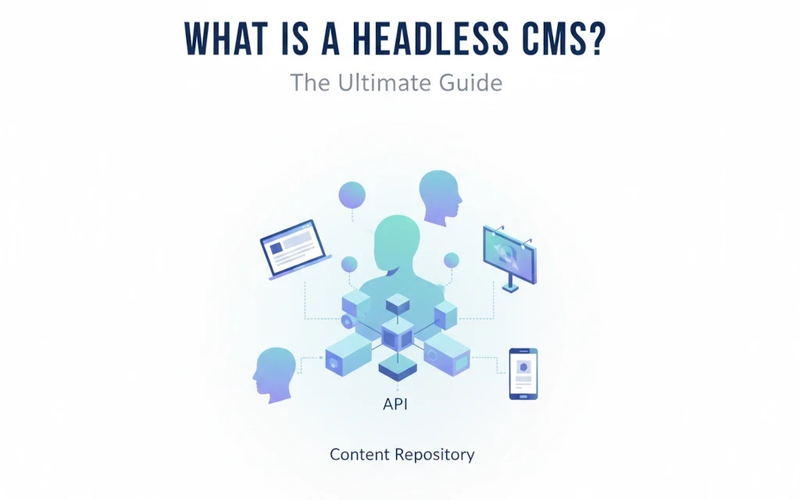
So, What on Earth is a Headless CMS?
You’ve probably heard the term "Headless CMS" popping up in marketing meetings or tech blogs, and chances are it was followed by a lot of confusing, technical jargon.
Let's cut through the noise.
A headless CMS is a content management system that only handles the backend of your website or app. It’s a "content-only" system. It doesn't care what your website looks like. It's not a website builder.
Its one and only job is to be a central, organized storage-closet for all your content (text, images, videos, product info, etc.). It then gives you a special key, called an API (Application Programming Interface), to unlock that closet and pull your content out to be displayed anywhere you want.
The name "headless" comes from this idea: it’s a “body” (the content repository) without a “head” (the frontend, or the part users see).
The Big Difference: Headless vs. Traditional CMS
To really get it, let's compare it to what most people know: a traditional, all-in-one CMS like WordPress.
- A Traditional CMS (like WordPress) is a monolithic system. It's an all-in-one package. It stores your content (the backend) AND controls how it’s displayed (the frontend) using themes and page builders. The "head" and the "body" are permanently attached.
- A Headless CMS is decoupled. The backend "body" is completely separate from any frontend "head." You write your blog post in the headless CMS, and then your developer can grab that same post and display it on your website, your iPhone app, your Android app, and even a digital billboard in Times Square.
If you're still a bit fuzzy, here's an analogy.
- Traditional CMS: This is like a pre-packaged LEGO set—for example, the Millennium Falcon kit. You get all the specific pieces and a detailed instruction manual. You can build a fantastic Millennium Falcon, but it's nearly impossible to use those exact same pieces to build a medieval castle.
- Headless CMS: This is like a giant bucket of universal LEGO bricks. The CMS just stores the bricks (your content). Your developers can then grab any bricks they need (via the API) to build the Millennium Falcon (your website), the castle (your mobile app), and a spaceship (your email newsletter).
Why Are So Many People Going Headless?
This approach isn't just a trend; it solves a lot of modern problems.
- Omnichannel Delivery (Write Once, Show Everywhere) This is the biggest win. You no longer have to copy-paste your content into five different systems. You update a product price in your headless CMS, and it instantly updates on your website, your mobile app, and your in-store kiosk.
- Total Developer Freedom Your frontend developers are no longer trapped by the restrictions of a WordPress theme. They can use any modern, fast technology they want (like React, Vue, or Angular) to build a lightning-fast, totally custom user experience.
- Better Security In a traditional CMS, your backend and frontend are in the same place, giving attackers one big target. By separating them, a headless CMS tucks your content "body" safely away from the public-facing "head," significantly reducing the attack surface.
- Scalability and Performance Because the frontend is separate, it can be hosted on modern, high-performance networks (called CDNs). This makes your site incredibly fast, which Google loves for SEO. It's also much easier to handle sudden spikes in traffic (like during a Black Friday sale).
What Are Some Popular Headless CMS Platforms?
The market is full of great options, but they generally fall into two categories: "SaaS" (hosted for you) and "open-source" (you host it yourself). Here are a few mainstream examples:
- Strapi: The leading open-source headless CMS. It's popular because it's self-hosted, giving you complete control over your data and code. It's known for its flexibility and developer-friendly customization.
- Contentful: A powerful, cloud-based (SaaS) platform aimed at large teams and enterprises. It's one of the original pioneers in the space and is known for its reliability and scalability for managing content across many global channels.
- Sanity: A highly developer-focused platform that offers a unique real-time, customizable editing environment called Sanity Studio. It gives developers total freedom to build the content backend from the ground up to match their exact needs.
- Storyblok: This platform is very popular because it features a built-in visual editor. This allows marketers and content creators to see live previews and edit the website visually, bridging the gap between headless power and traditional convenience.
- Decoupla: A straightforward and simple platform, Decoupla is another option, especially for those who want to get up and running quickly. It provides all the core headless features like custom content types, media management, and a flexible GraphQL endpoint that automatically generates its schema based on the content models you create.
Is a Headless CMS Right for You?
So, should you ditch your old system and "go headless" right now? Not always.
A headless CMS is a powerful tool, but it's not the right fit for everyone.
A Headless CMS is likely a great fit if:
- You need to publish content to multiple platforms (e.g., website + mobile app).
- You have a development team (or agency) that wants to use modern tech stacks.
- You prioritize site speed, security, and scalability above all else.
- You want a completely custom-designed website, with no templates.
A Traditional CMS might be a better fit if:
- You just need a simple blog or a standard business website.
- You are a solo user or have a small team with limited technical skills.
- You want to get a site up and running quickly and cheaply using pre-built themes and plugins.
In short, a headless CMS gives you ultimate power and flexibility in exchange for requiring more technical know-how to set up. It’s the future of digital experiences, allowing brands to build whatever they can dream up, powered by a single, central source of content.